Decoder-only large language models (LLMs) struggle with table reasoning because tables must be serialized,
which can obscure row- and column-level structure. Prior graph and hypergraph approaches encode structure
with an external encoder, but their gains are often inconsistent under autoregressive decoding. We analyze
how tabular structure is represented inside decoder-only LLMs and find that row and column relations are
concentrated in a small subset of layers and attention heads. Based on this observation, we propose
HInT (Hypergraph Infusion for Table reasoning), which injects hypergraph-derived
structural features directly into the layers where these relations are concentrated. HInT constructs a table
hypergraph over cells and headers, applies lightweight message passing, and fuses the resulting structural
features with token hidden states through gated fusion. Experiments across diverse table reasoning tasks
show consistent improvements over text-only baselines and prior (hyper)graph-based methods.
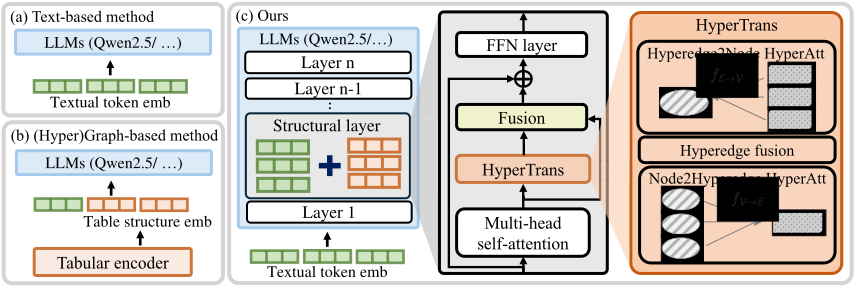
Method overview (Figure 3 in the paper).
(a) Text-based methods process tables after linearization into token sequences.
(b) Graph- and hypergraph-based methods first construct a graph or hypergraph from the table, encode it with a
dedicated encoder, and pass the resulting embeddings to the LLM.
(c) HInT injects hypergraph-based structural features directly into selected structural layers of
the LLM, where they are fused with hidden states to enable structure-aware reasoning.
Introduction
Decoder-only LLMs reason over tables by reading them as serialized token sequences. This linearization obscures
row- and column-level relations: tokens that are adjacent in a row or column may be far apart in the input
sequence, so structure-sensitive reasoning becomes brittle. Recent work tries to compensate by introducing external
graph or hypergraph encoders that inject structural features before LLM decoding.
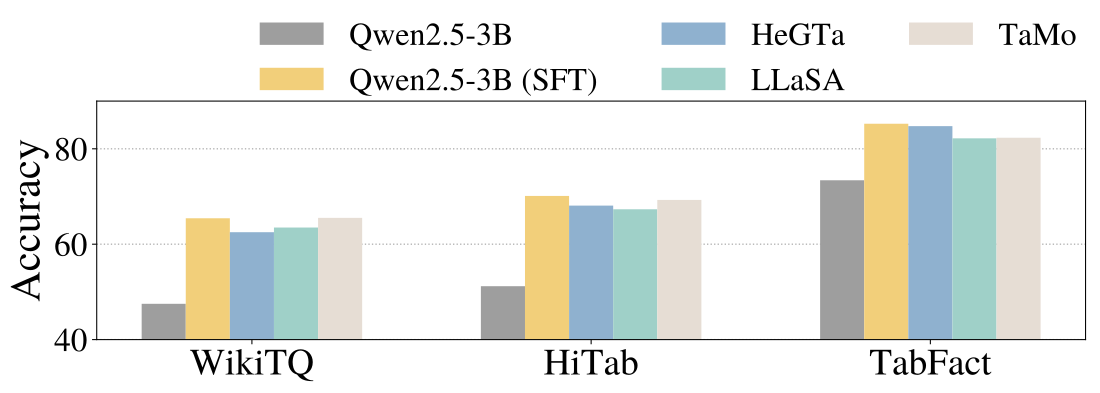
We find that this is not enough. On WikiTQ, HiTab, and TabFact, (hyper)graph-augmented LLMs do not consistently
outperform text-only baselines — in several cases, they match or underperform supervised fine-tuning on the
same backbone. Our analysis suggests that the bottleneck is not just in extracting table structure, but in
integrating it into the autoregressive computation inside the LLM.
Figure 1 in the paper. Comparison of text-only and graph-augmented LLMs on the WikiTQ, HiTab, and TabFact
datasets. Despite explicitly modeling table structure, graph-augmented methods do not consistently outperform the
text-only baselines.
Where is table structure encoded inside the LLM?
We define two binary structural masks — a row mask $\mathbf{M}^{\text{R}}$ and a column mask
$\mathbf{M}^{\text{C}}$ — that mark which token pairs belong to the same table row or column. For each
instance, we then fit each mask as a sparse linear combination of attention maps across all layers and heads with
a LASSO penalty:
Heads with large coefficients are the ones whose attention patterns best align with row- or column-wise structure.
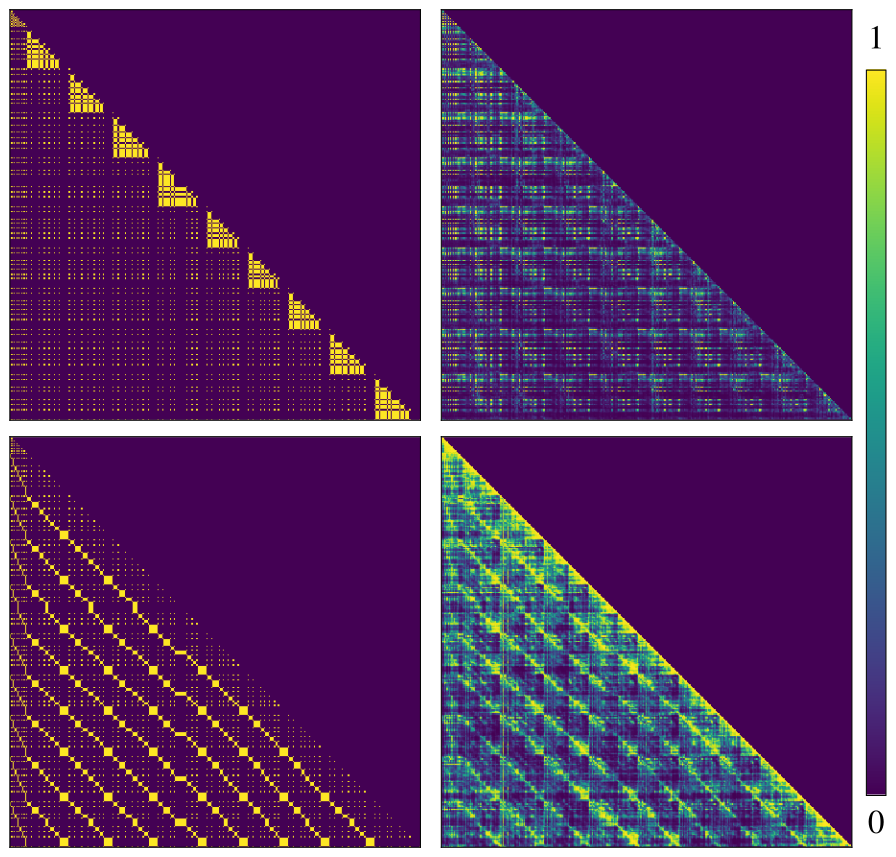
Visualizing the top-ranked heads recovers clear row-wise and column-wise patterns even though the input is a
1D token stream.
Figure 2 in the paper. Left: row and column structural masks $\mathbf{M}^{\text{R}}$ (top) and
$\mathbf{M}^{\text{C}}$ (bottom). Right: attention maps from heads selected by our structural probing, showing
row-wise and column-wise patterns that best match the corresponding masks.
These heads are not just visually suggestive — they are functionally critical. Ablating the top-40
structurally aligned heads at inference time causes a much larger drop in WikiTQ accuracy than ablating the same
number of randomly chosen heads (12.73% vs. 32.29% EM, compared to 47.51% with all heads). Aggregating these heads
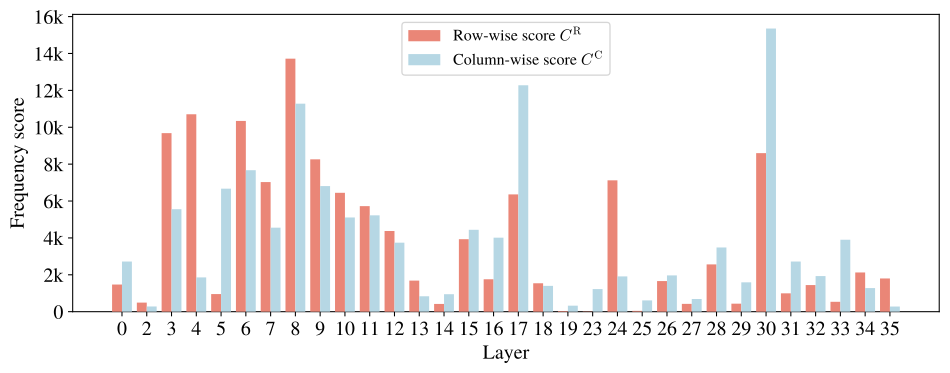
across instances shows that they concentrate in a small, non-uniform subset of transformer layers, which we
designate as the structural layers $\mathcal{L}^{\star}$.
Table 1: Ablating structural vs. random heads on WikiTQ.
Figure 6: Per-layer frequency of structurally aligned heads — row- and column-related structure is concentrated in a small subset of layers.
Method: HInT
HInT (Hypergraph Infusion for Table reasoning) builds a table hypergraph
$\mathcal{G} = (\mathcal{V}, \mathcal{E})$ in which every cell is a node and rows, columns, and hierarchical
headers are hyperedges. At each structural layer $l \in \mathcal{L}^{\star}$, we
(1) pool token hidden states into per-cell node features $\mathbf{v}_u$ and per-header hyperedge features
$\mathbf{e}_v$;
(2) run a lightweight HyperTrans message-passing block over $\mathcal{G}$ to obtain structure-enhanced features
$(\widetilde{\mathbf{V}}, \widetilde{\mathbf{E}}) = \mathrm{HyperTrans}(\mathbf{V}, \mathbf{E})$;
and (3) fuse the resulting structural feature $\widetilde{\mathbf{g}}_i$ back into each token via a sigmoid gate
$\alpha_i = \sigma(\mathbf{w}^{\top}[\mathbf{u}_i \| \widetilde{\mathbf{g}}_i])$ and a convex combination
$\widetilde{\mathbf{u}}_i = (1-\alpha_i)\,\mathbf{u}_i + \alpha_i\,\widetilde{\mathbf{g}}_i$.
All other layers are left untouched, so the standard autoregressive computation is preserved. Only the HyperTrans
block, the gate $\mathbf{w}$, and (optionally) the backbone are trained.
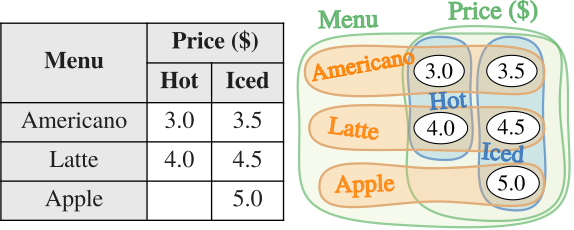
Figure 4 in the paper. Example hypergraph construction. Each table cell is a node. Row-wise (orange) and
column-wise (blue) hyperedges group cells that share a row or column, while hierarchical headers (green) induce
higher-level hyperedges (e.g., Price ($) spanning Hot and Iced).
Results
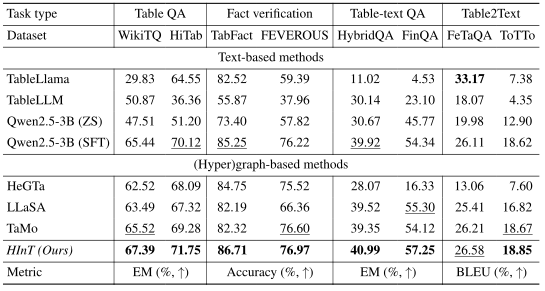
Using Qwen2.5-3B-Instruct as the backbone, HInT identifies 12 structural layers
$\mathcal{L}^{\star} = \{3,4,5,6,8,9,10,12,15,17,24,30\}$. With this single layer set fixed across all benchmarks,
HInT yields consistent gains across table QA (WikiTQ, HiTab), fact verification (TabFact, FEVEROUS),
table–text QA (HybridQA, FinQA), and table–to–text generation (FeTaQA, ToTTo), and
outperforms both text-only and prior (hyper)graph-based baselines (HeGTa, LLaSA, TaMo).
Table 2 in the paper. Results on eight table-reasoning benchmarks across four task categories. HInT is the
best or second-best method on every benchmark.
Qualitative example
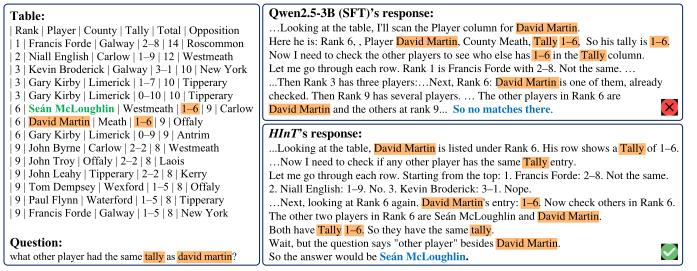
On a representative WikiTQ instance that requires multi-step row-wise reasoning (find another player with the same
tally as David Martin), the text-based baseline correctly retrieves David Martin's tally
(1–6) but fails to propagate the row-wise constraint to the other player at the same rank. HInT
preserves the row-level dependency and correctly answers Seán McLoughlin.
Figure 5 in the paper. Reasoning comparison on a WikiTQ test example. Top-right: Qwen2.5-3B (SFT) finds the
correct tally but fails to propagate the row-wise constraint, yielding an incorrect answer. Bottom-right: HInT
preserves the row-level dependency and answers correctly.
Where to inject matters
Injecting hypergraph features into the identified structural layers outperforms (i) a capacity-matched Qwen2.5-3.3B
baseline, (ii) injecting into randomly selected layers, and (iii) injecting into all layers. This
confirms that the gains come from where structure is added, not from extra parameters or denser
intervention.
The same recipe also transfers to a different backbone family: with Llama-3.1-8B-Instruct, the layer-frequency
distribution stays sparse, and HInT improves over both the SFT and TaMo variants of the same backbone.
Conclusion
Tabular structure is already encoded inside decoder-only LLMs, but only in a small subset of layers and attention
heads. HInT exploits this by injecting hypergraph-derived structural features directly into those structural
layers via lightweight message passing and token-level gated fusion, without changing the underlying autoregressive
computation. The result is consistent improvements over strong text-only and encoder-based baselines across diverse
table reasoning tasks. The same principle — injecting structured relational information into internally
aligned layers — is not inherently limited to tables and is a natural direction for other structured inputs
such as knowledge graphs or program representations.
Citation
If you find our work useful, please cite it as:
@inproceedings{leehint,
    title     = {HInT: Hypergraph Infusion at the Structural Layers Improves Table Understanding},
    author    = {Lee, Wonjin and Jeong, Soomi and Kim, Kwang In},
    booktitle = {Forty-third International Conference on Machine Learning}
}