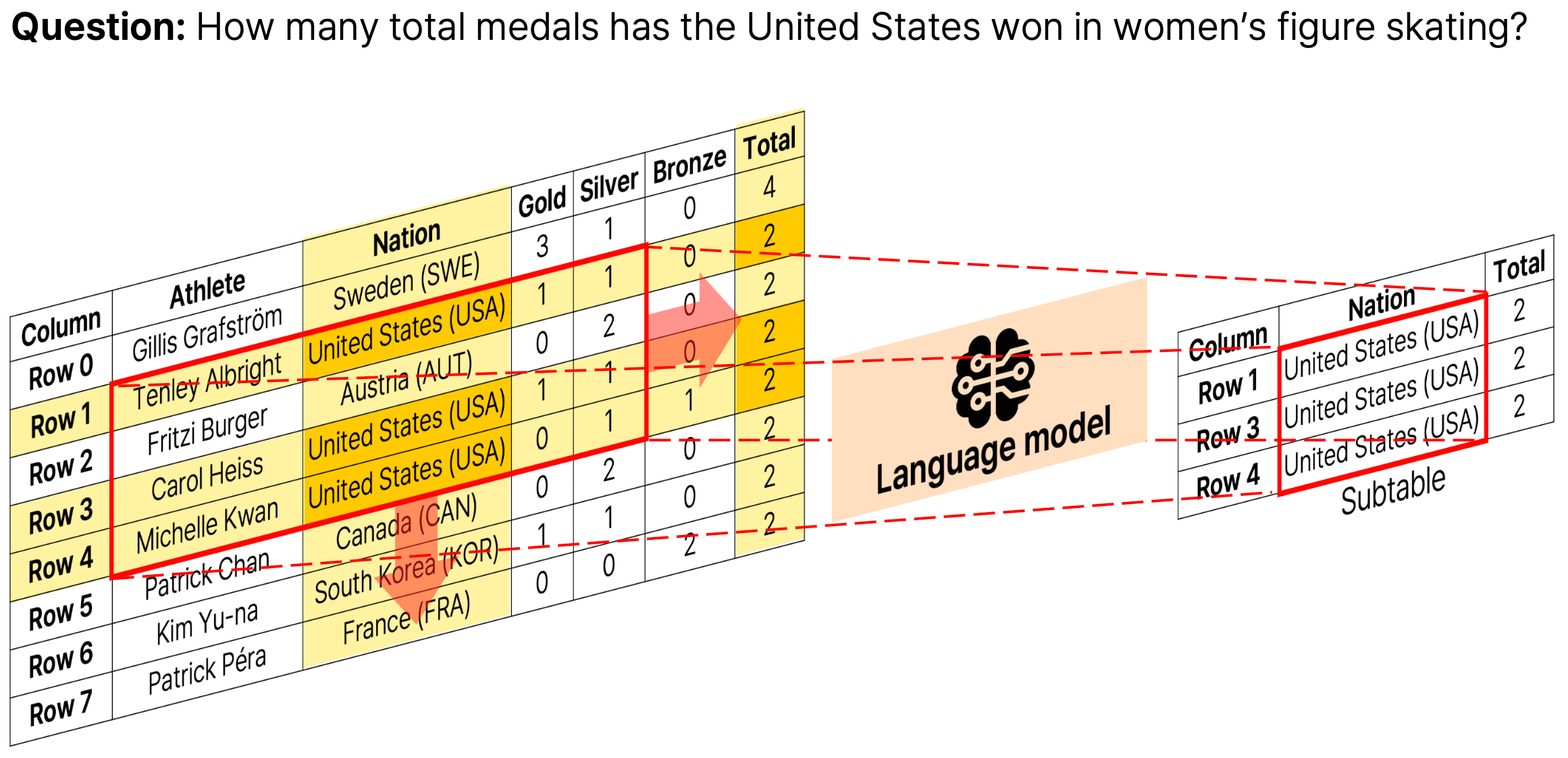
Applying language models (LMs) to tables is challenging due to the mismatch between the two-dimensional
structure of tables and the one-dimensional inputs expected by LMs. This mismatch forces linearization,
making LMs particularly sensitive to irrelevant cells. Subtable selection mitigates this challenge by
isolating question-relevant content prior to answer generation. However, existing approaches either rely
on independent row or column selection, failing to capture cross-row and cross-column dependencies, or
attempt global reasoning and face challenges similar to holistic table QA under noisy contexts. We propose
PieTa (Piece of Table), a divide-and-conquer subtable selection framework that
progressively aggregates locally selected evidence without requiring explicit global reasoning. PieTa uses
an iterative, window-based multi-resolution process to construct compact subtables that capture global
dependencies while limiting LM exposure to irrelevant content. Extensive experiments demonstrate that PieTa
consistently outperforms prior subtable-based and holistic table QA approaches.
Figure 1 in the paper. Overview of the proposed PieTa framework. Given an input table and a
question, PieTa synthesizes a subtable by iteratively dividing the table into smaller windows, selecting relevant
cells within each window using a language model, and merging the resulting subwindows. The process repeats until
the final subtable is formed.
Why subtable selection?
Tables are inherently two-dimensional, but language models read them as a linearized 1D token sequence. The
linearization forces evidence cells and irrelevant cells into the same context, and only a small fraction of cells
actually grounds the answer. As a result, LM readers can be easily distracted by noise — even with table-aware
pretraining or careful prompting.
Subtable selection reduces this noise by isolating a small, question-relevant subset of the table before
answer generation. But existing selectors fall into two failure modes:
(1) Independent row/column scoring (e.g., ITR) is fast but misses cross-row and cross-column dependencies.
(2) Joint global selection (e.g., Dater, TabSQLify, "Holistic LM") tries to reason over the whole table but
inherits the same long-context distraction it was supposed to remove.
PieTa avoids both pitfalls by working at moderate resolutions: it always feeds the LM only a
$w \times w$ window, and lets a union over many window-level selections reconstruct global structure.
Method: Divide — Conquer — Combine
Given a table $T$ and question $Q$, PieTa iteratively applies three steps:
Divide. Slide a $w \times w$ window over the current table $T^{t}$ to obtain overlapping windows
$\{W_i\}_{i=1}^{N}$.
Conquer. A fine-tuned LM-based subwindow selector $\mathcal{S}'$ extracts the relevant subwindow
$\widehat{V}_i = \mathcal{S}'(\mathcal{P}(W_i, Q))$ inside each window.
Combine. The new table $T^{t+1}$ is the union of all selected subwindows
$T^{t+1} = \bigcup_i \widehat{V}_i$.
The loop terminates when the table no longer changes ($T^{t+1} = T^{t}$). This converges to a compact subtable that
contains roughly 14% of the original cells while reaching downstream QA accuracy comparable to gold subtables.
Figure 2 in the paper. Example of training data generation for the subwindow selector with window size
$w = 4$. The selector is trained on windows sampled from WikiSQL/SQUALL; the target subwindow inside each window is
built from the condition and answer columns under the question's constraints. Even though the per-window targets
are local, their union across windows reproduces a table that supports the correct global answer.
Coordinate representation for the selector output
A key design choice is how the LM emits the selected subwindow. Two natural options — (a) index
(row/column ids only) and (b) table (regenerate the cells) — both fail when the relevant header is
missed: index loses the content that disambiguates rows, and table emission compounds autoregressive errors. PieTa
introduces a (c) coordinate representation that preserves the window's spatial structure while emitting
explicit <row, col> tokens for selected cells and <φ, φ> for unselected
ones. This recovers cells even when their column header was overlooked.
Figure 3 in the paper. Comparison of subtable representations on a $4 \times 4$ window. Index and table
representations miss the cell safe because the column Placement is not selected; the
coordinate representation preserves the window structure and recovers the relevant cell.
Results
PieTa is evaluated on three benchmarks: WikiTQ, WikiSQL, and the hierarchical HiTab. We pair
it with both specialized readers (TaPEx, OmniTab) and general-purpose readers (GPT-3.5, Gemini 2.0, DP&Agent),
and compare to ITR, Dater, TabSQLify as well as holistic QA models (Binder, StructGPT, CABINET, Chain-of-Table,
ReAcTable). Across almost every reader configuration, PieTa gives the strongest reader the strongest
subtable, and it also gives the largest absolute gain over the holistic (no-selection) baseline.
Table 5 in the paper. Exact-match accuracy (%) on WikiTQ, WikiSQL, and HiTab. (Top) Selector-based QA pairs
each subtable selector with multiple readers; "–" denotes the holistic setting (no selection).
(Bottom) Additional holistic QA baselines. PieTa is best or second-best for nearly every reader.
PieTa scales gracefully with table size and answer-cell distance
Holistic readers degrade sharply on large tables, and prior selectors degrade when relevant cells are far apart in
the linearized stream. PieTa's union-based, multi-resolution construction stays effective in both regimes —
because every individual LM call still sees only a small $w \times w$ window, but cross-window union recombines
distant evidence.
Figure 4: EM (%) across table sizes on WikiTQ (top) and WikiSQL (bottom).
Figure 5: EM (%) on WikiSQL as the maximum distance between answer cells grows.
Selection quality
On the WikiSQL test set, PieTa improves selection precision over ITR by +47.4 percentage points while keeping
recall above 99%. Recall stays high across varying numbers of condition columns and answer rows — the
property that matters most for downstream QA, since missing evidence cells cannot be recovered by the reader.
Table 4 in the paper. Manual-annotation subtable selection results on WikiTQ and HiTab. PieTa attains the
highest recall on both, indicating that it reliably preserves the evidence required for answering.
Conclusion
PieTa shows that you do not need the LM to reason over the entire table to pick a good subtable. By restricting
each LM call to a small window and reconstructing global structure through a union over windows, PieTa avoids the
long-context distraction that hurts holistic selectors and the missed cross-dependencies that hurt
row/column-independent selectors. The result is consistent, reader-agnostic gains over prior subtable selection
and holistic QA approaches on WikiTQ, WikiSQL, and HiTab.
Citation
If you find our work useful, please cite it as:
@inproceedings{lee2026piece,
  title={Piece of table: A divide-and-conquer approach for selecting subtables in table question answering},
  author={Lee, Wonjin and Kim, Kyumin and Lee, Sungjae and Lee, Jihun and Kim, Kwang In},
  booktitle={Proceedings of the 64th Annual Meeting of the Association for Computational Linguistics (Volume 1: Long Papers)},
  pages={31672--31688},
  year={2026}
}